Cartier’s Kyoto HQ promotes sensory stimulation
:strip_exif():strip_icc()/filestorage/images/111643/cartier-hanzomon-015.jpeg) Cartier Tokyo office, Japan
Cartier Tokyo office, Japan
:strip_exif():strip_icc()/filestorage/images/111644/cartier-hanzomon-032.jpeg) Cartier Tokyo Office, Japan
Cartier Tokyo Office, Japan
:strip_exif():strip_icc()/filestorage/images/111645/cartier-hanzomon-029.jpeg) Cartier Tokyo office, Japan
Cartier Tokyo office, Japan
Japan – The luxury jewellery brand has unveiled a sensorially driven headquarters building for its Kyoto-based workers. Together with Tokyo studio I IN, Cartier captures the brand’s luxurious heritage in harmony with Japanese aesthetics and traditions, using the brand’s signature red throughout the space in plush interiors, as well as champagne gold in floor-to-ceiling louvre panels.
Artisanal elements also root the space in Japanese identity, with elements including a tatami-matted platform whose piping was created by Kyoto-based artisans Hosoo. By elevating conventional working environments in this way, Cartier aims for its staff ‘to feel and touch the brand’s identity every day on a deeper level’.
Meanwhile, the tatami-matted platform invites wellbeing into the workplace. In a press release, the brand describes this area as: ‘A space to take off your shoes to relax, stretch and decompress, it pays homage to Japanese aesthetics and honours Cartier’s principles of artisanal quality and innovation.’
As Itai Palti writes for LS:N Global, science-informed approaches to workplace design can drastically improve employee creativity and productivity.
Strategic opportunity
Businesses should embrace experimental approaches to workplace design, welcoming opportunities to explore the senses while still maintaining functional elements
Dutch Invertuals examines our planet-centric future
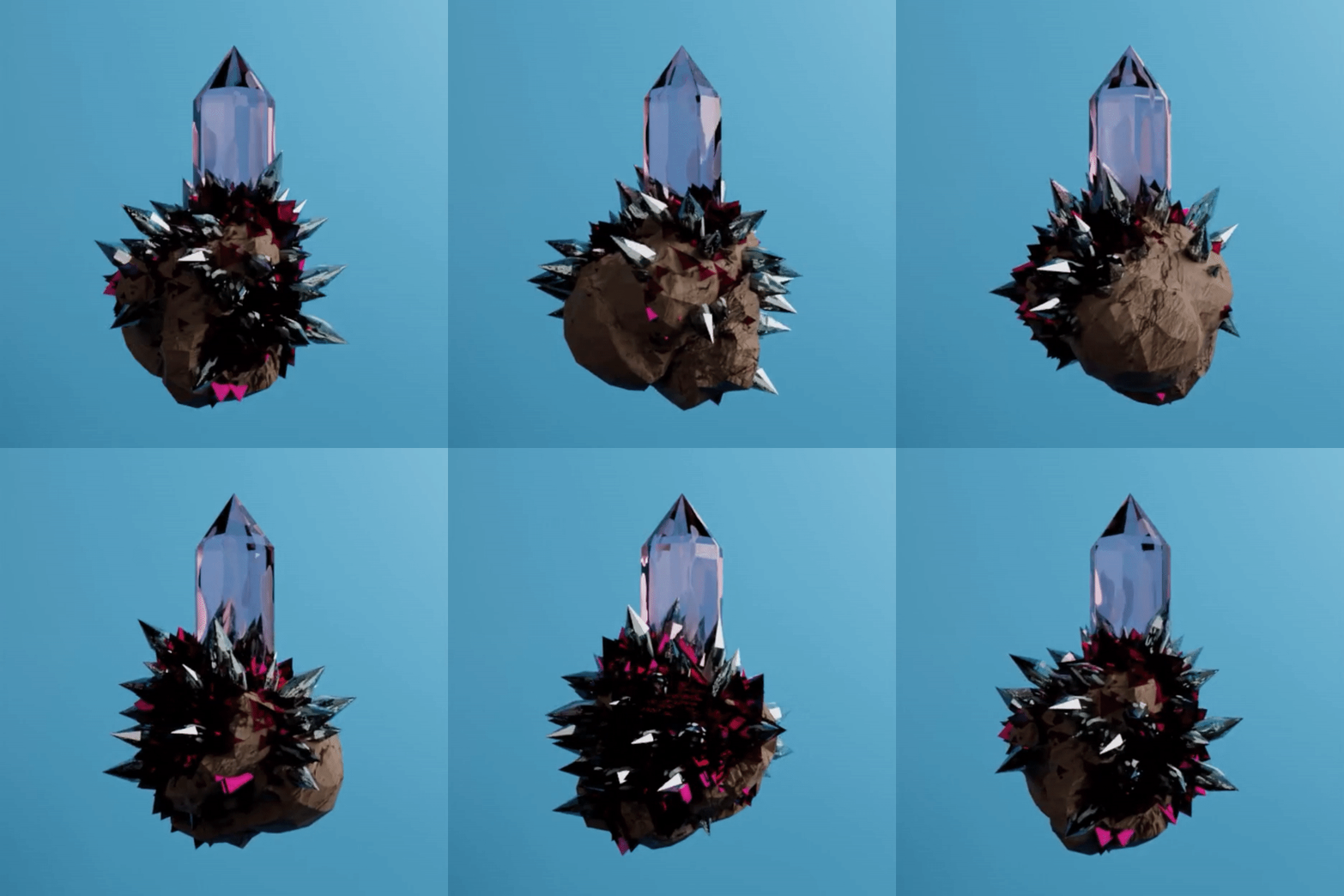 Amethustos by Dutch Invertuals and Edhv for Expedition Æqualis, The Netherlands
 Delphinium 001 by Dutch Invertuals and Delphine Lejeune for Expedition Æqualis, The Netherlands
Global – Design collective Dutch Invertuals is examining the future of the natural world through a digital lens, as part of a collaborative exhibition at New York’s The Future Perfect gallery. Featured designers include Ada Sokół, Edhv Studio, Ausblau, Dae Uk Kim and Delphine Lejeune. Created with The Future Laboratory and experience design company Philips Design, the Expedition Æqualis exhibition marks the beginning of a three-year interdisciplinary design-research project. Its ultimate aim is to work towards a world that integrates all life systems, achieves biodiversity and encourages cultural diversity.
Part of the exhibition includes a carefully curated selection of digital artefacts that serve as part of a Web3 encyclopaedia. When these are sold as non-fungible tokens (NFTs), owners become ambassadors in the project. Artefacts include digitised seeds, alongside a variety of digital crystals and stones that aim to ignite a renewed imagination for the natural world. ‘We utilise the endless possibilities of Web3 technology to gain a better understanding of nature’s ingenuity and characteristics, and to discover how we can positively integrate its principles into future building blocks,’ explains the studio.
To discover more about how our eco-centric future will affect everything, look out for our upcoming Interspecies Architecture article, and join the Expedition Æqualis mission by becoming a member.
Strategic opportunity
With design moving from human-centric to planet-centric principles, there is an opportunity for brands to use creativity to facilitate positive change and planetary betterment
A blueprint for fighting inner-city gentrification
London – Recognising the negative impact of gentrification across UK cities, author and activist Nabil Al-Kinani is working to protect the culture and affordability of social housing estates. His latest project is a manifesto and blueprint, Privatise the Mandem, which provides a comprehensive step-by-step guide on achieving collective ownership. The guide, which is launched alongside a privatisation hotline, allows at-risk communities to acquire the freehold of their buildings through legislative tools.
According to Al-Kinani, Privatise the Mandem forms part of a bigger movement that will evolve to benefit future generations. As the project develops, future iterations will address questions such as: ‘How do we compete against the emerging 15-minute cities?’ Through this initiative, Al-Kinani is raising broader awareness of the damage of gentrification in our future cities, while also providing individuals with tools to preserve their local areas.
We’ve also explored the uprising of micro-societies through the lens of Decentralised Care, considering the initiatives that are infusing local communities with solidarity, trust and care.
:strip_exif():strip_icc()/filestorage/images/111646/img-5057.jpeg) Privatise The Mandem by Nabil Al-Kinani, UK
Privatise The Mandem by Nabil Al-Kinani, UK
Strategic opportunity
As a broader shift towards collectivism takes hold, reflect on the ways you can support local communities through spaces and services that protect people’s livelihoods
Stat: Eco-conscious Peruvians are willing to sacrifice meat
:strip_exif():strip_icc()/filestorage/images/111647/23-05-22.jpg) Mil, Peru
Mil, Peru
While global awareness of the climate crisis is growing rapidly, many consumers are still unwilling to make dietary changes to protect the planet. But a study of 31 countries by Ipsos reveals that many countries around the world are adapting their mindsets to eating less meat.
While expectations tend to fall on the West, the study found that Peru is leading the way in this shift, with 64% of Peruvians saying they’re likely to eat less meat as a way to cut their climate change impact. This was followed by Mexico (61%) and China (60%). At the other end of the scale, more than two in three (69%) people in Japan are concerned about climate change in their country, but just 29% of people say they’re likely to eat less meat for climate change reasons.
With a global community of Low-impact Eaters gradually leading a mass switch to plant-based diets, innovation is still needed to develop alternative proteins that appeal to the nuanced tastes of particular regions.
Strategic opportunitiy
Plant-based meat brands have an opportunity to create products that specifically appeal to the taste preferences of particular regions, without leaning too heavily on climate-related communications
:strip_exif():strip_icc()/filestorage/images/131922/healf-experience-26-4.jpg)
:strip_exif():strip_icc()/filestorage/images/132014/jml-fy26-brit-lp-carrot-4.jpeg)
:strip_exif():strip_icc()/filestorage/images/131905/img-1332-2400.jpg)
:strip_exif():strip_icc()/filestorage/images/131968/marian-brannelly-3.png)
:strip_exif():strip_icc()/filestorage/images/131988/015.png)
:strip_exif():strip_icc()/filestorage/images/131954/ai-imagery-by-the-future-laboratory.png)
:strip_exif():strip_icc()/filestorage/images/131895/copy-of-copy-of-0b962822-c254-4e22-853f-ce0840aaa811.png)
:strip_exif():strip_icc()/filestorage/images/131887/scratch-and-sniff-by-billie-new-york-us.jpg)
:strip_exif():strip_icc()/filestorage/images/131810/echo-buds-shot-1.jpg)
:strip_exif():strip_icc()/filestorage/images/131877/2025-04-dv2069-r2.png)
:strip_exif():strip_icc()/filestorage/images/132031/enanei-store-01.jpg)
:strip_exif():strip_icc()/filestorage/images/132036/26-05-3582-03c-bby-str-microdart-stars-srgb300-2x3.jpg)
:strip_exif():strip_icc()/filestorage/images/102540/06-purpose.png)
:strip_exif():strip_icc()/filestorage/images/132027/screenshot-2026-07-13-at-09-06-54.png)
:strip_exif():strip_icc()/filestorage/images/130827/ben-klewais-nle3elaqa6a-unsplash.jpg)
:strip_exif():strip_icc()/filestorage/images/105847/02-belonging.png)
:strip_exif():strip_icc()/filestorage/images/132002/screenshot-2026-07-07-at-16-04-23.png)
:strip_exif():strip_icc()/filestorage/images/131836/pinterest-predicts-2026-scent-stacking.png)
:strip_exif():strip_icc()/filestorage/images/105715/07-identity.png)
:strip_exif():strip_icc()/filestorage/images/131997/tnc-pr-insitus-d48-bauer-20260623-tnc-003a4685-handful-copy.jpg)